Pages

Showing posts with label Charlotte Mason Method. Show all posts

Saturday, September 3, 2016

BLISS (Or What We're Doing for 5th Grade Home School)


Welcome to BLISS!
What's that?

Blossom Lane Institute of Spunky Sparkle.

Really.

That's what we decided to name our home school this year. She came up with the spunky sparkle part, because she's all about that. And I love the acronyms. I couldn't resist this one. It sums up what I want our school to be, which is anything but dull and pointless. We're happy to be together.

Every morning we point to the glittery BLISS letters on our school supply bins and chant: "Blossom Lane Institute of Spunky Sparkle!" Then we give a high five and say, "Welcome to BLISS!" 

That's how we start our day. It's the best. And if we hit a little rough spot and get cranky, we go back to our happy chant and start over again.


~*~*~

This year, as with the last two, I only have my youngest daughter home for school. It's been so much less complicated teaching just one than several at a time. She's in 5th grade, so I just love getting to dig in deeper with her.

She will probably go to public school next year. So that means I need to make sure she's up to speed on all of her basic skills, as well as teach her whatever content I want to make sure she gets before I send her off to middle school.

Here's our plan...

For math, we do flash card and oral drill to keep her multiplication facts fluent. She's finishing up a basic math workbook from last year, and then we'll move on to Spectrum 5th Grade math. She does Sum Dog and other math game web sites on-line.

For language arts, she has a Spectrum 5th grade Reading comprehension workbook, a Grammar Minutes workbook left over from last year, the Writer's Express text that I used with some of her older siblings, and a writing prompts journal. I have other resources available for later in the year, but this is enough for now. She's doing creative writing on her own a few times a week on the computer.  Plus, she chooses a novel to read on her own for literature. Right now it's Mr. Popper's Penguins.


I keep her daily books and flash cards in a basket on the floor so I can reach in easily and hand her the next one when we're working together in the morning. I marked the top of each one with the subject so I can find them easily from the top at a glance. I also have a larger basket with other resources we don't use daily but want to have handy.


The real fun for me is social studies. This year we'll be in a world geography co-op on Mondays where she will learn about culture and mapping. There isn't any homework (yay!) so the other four days we get to do our own thing. Last year my goal was to cover world history from the earliest civilizations up through the Middle Ages. We didn't finish the Middle Ages, so I decided to pick up with that again and go as long as we want. Then we'll move on to the Renaissance and Reformation era, which I'm guessing will take us up to Christmas or even beyond. I want to take the scenic route through this period of history since there is so much to learn. We love art and music, and I have a bunch of great children's biographies and historical fiction with important concepts! The public schools do world history in 6th grade, so I'm not worried if we miss some of the later time periods. However far we get, I'll at least leap frog forward to World War 2 and Holocaust studies at the end of the year.

One of the key resources we are using right now is What Really Happened in the Middle Ages, a collection of short biographies compiled by Terri Johnson. So far we have read chapters about Theodora and Alcuin.


This one below is from my own childhood in California. I have several in the series. I wondered as a young home school mom over 20 years ago where these had gone. Oddly enough, I found them in my grandparents' attic in Pennsylvania. I have loved using them with each of my children here in Florida. They are easy to understand with great words to learn for vocabulary. 


So far with both of those books, I have started a spiral notebook for copy work. I jot down several phrases or sentences with key facts for each story and she copies them either while I read to her or later on. I encourage her to use her best handwriting, and pay attention to spelling and punctuation. She also does oral narrations of whatever we read, telling me what she remembers from the story. These are Charlotte Mason approach methods. 

Here is a sampling of some other books we'll be using for the Middle Ages and then the Renaissance and Reformation era.


For science, we are taking the opposite approach. In the past, we've done unit studies on various science topics but they haven't been very comprehensive. I don't know where I found this 5th grade text, but it's a thick and visually attractive book with chapters on all the major science topics to fill in whatever gaps she has. So far we've learned about cells and part of classification for living things.


Our whiteboard easel always comes in handy for science.


We also had a membership at the Orlando Science Center, which just expired, but we managed to pack in four visits in the first few weeks of school, once with two of my grandchildren.


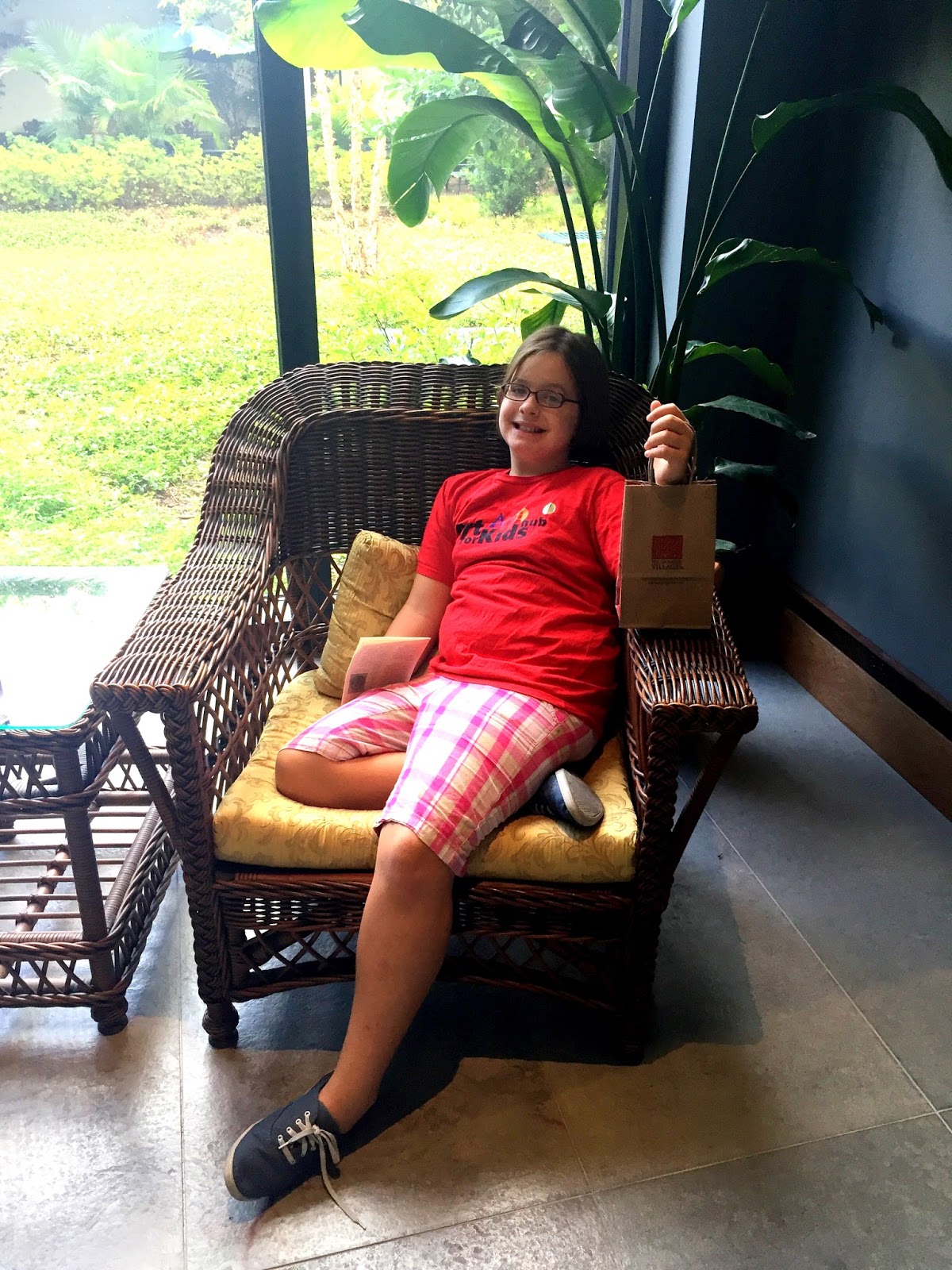
My daughter is an enthusiastic artist. Her favorite YouTube channel is Art for Kids Hub which features drawing videos. She has hundreds of drawings in her portfolio. We organized all of her art supplies into a rolling cart which she stores in her bedroom closet. I think she spent far more on art supplies as the school year started than we did on other school materials. She has dabbled in acrylic paints. We'll do more tie dye this year, and we're both going to learn how to use a wood burning tool. She's already a pro with a hot glue gun.


Like me, she is also an art museum fanatic. We have visited six of the local museums, some of them more than once. Last week, we took a spontaneous trip to one of our favorites, the Morse Museum of American Art, which claims the largest collection of stained glass work from the studio of Louis Comfort Tiffany and his colleagues.



One craft project that we did is making calming glitter jars. That's definitely a lot of spunky sparkle!


She also loves to cook, so she's done several kitchen projects like pancakes, eggs, cookies, smoothies, and other yummy treats. Of course I'm glad she gets extra hands on practice with planning, reading instructions, measuring, food safety, and other practical skills. 


So that's what we've got going so far!

Related posts:


God bless!
Saturday, February 28, 2015

Eclectic Home Schooling: Gathering Up Bits of the World

Eclectic Home Schooling: 
Gathering Up Bits of the World


“Gathering up bits of the world and laying them out in an order her children can understand.” What a description of a mother who chooses the eclectic approach to home schooling!  

My third grade daughter Melody went for a speech therapy evaluation at A.LL Therapy Connection, and I spotted this quote on a piece of wall sculpture as soon as we walked into the waiting room. It is also available as a print with a whimsical graphic design. Nearby, I found the mosaic of a woman with children; it's made up of gathered bits and pieces of color. What else can you find in the picture? Delightful! 


Picture of a polar bear jumping from one piece of pack ice to the next
My favorite polar bear picture
We loved the therapist and the intern, and were pleased with their thorough assessment. We'll be going back twice a week starting next month, and the appointments and daily practice will be a vital part of her education. As we walked out of the therapy room, I commented to therapist about how observant my daughter is of things around her. Just at the moment, Melody asked me, “What is Polar Bear Day?” Huh? She pointed to a calendar on the wall: February 27, Polar Bear Day. Alrighty. That's a question for Google! It's also a “bit of the world” that I want my daughter to understand. Later in the evening, we enjoyed the awesome polar bear pictures here: Polar Bear Conservation at National Geographic


After we left the speech therapy place, we headed to the mall to find an Auntie Anne's pretzel shop. We had a BOGO coupon we'd gotten when they came to do a demonstration at our home school group. We rarely go to the mall, so we didn't know where the store was. Time for some life skills! I had Melody locate Auntie Anne's on the directory list and then on the diagram. Which way do we go? She figured it out and we got there! Yum!

Those are just a few ways this eclectic mama lays out the bits of the world for a little one to understand! What are some other methods we use to gather and present information?

Unit studies: 

In our early years of home schooling with my older kids (now teens and adults), we always used unit studies to cover history, geography, science, literature, creative writing, art, music, and even a little math enrichment. Now that we are no longer in formal academic co-op classes where curriculum was chosen by other teachers, we're back to the original plan! 

Right now we are studying the Civil War and late 1800's era for history. I didn't want to get too much into memorizing factoids or exploring the gore of war. Melody is still in the idea ~ story ~ picture phase of home schooling, and she loves biographies. I loaded up on both chapter books and picture books about famous people like Abraham Lincoln, Harriet Tubman, Sojourner Truth, Frederick Douglass, Harriet Beecher Stowe, Mary McLeod Bethune, Booker T. Washington, George Washington Carver, Robert E. Lee, Helen Keller, Alexander Graham Bell, and Clara Barton. (We visited Clara's historic American Red Cross home in Maryland earlier this month.) 

We are also halfway through the American Girls series about Addie, an escaped slave. We have lots of the Cornerstones of Freedom series about specific happenings in the time period, such as the Underground Railroad and the transcontinental railroad. 


Are we reading about the actual war? Yes, a little. We're reading What Was the Battle of Gettysburg? by Jim O'Connor, which starts with an excellent overview of what issues and events led to the Civil War. 

Read more about unit studies here: How to Plan a Unit Study and American History Unit Studies at Our House.

YouTube and Google: 

What a goldmine! Any topic we want is right there on-line. I always have my iPod in my pocket, so sometimes when we're reading a library book, we'll look up something related to an interesting fact or a question she has. (Who was the president before Abraham Lincoln? Look it up!) We have the old NEST Animated Heroes videos that my mom gave us years ago, but not a working VHS player. We found a treasure trove of them on YouTube here: Animated Hero Classics. I have her watch these on my laptop when I need to do something else nearby. We also use YouTube videos to explain math concepts like multi-digit multiplication. She likes the ones produced by MathAntics. The new YouTube Kids app for mobile iOS and Android mobile devices – perfect for a child's tablet. I can't try it out yet because it requires iOS 7, but you can find it in your app store.

PBS Kids: 

On TV or on-line, PBS Kids is a marvelous educational resource. On their web site, www.pbskids.org, you can find videos, games, and interactive activities. At their teacher resource site, www.pbslearningmedia.org, it is easier to find the specific subjects and grade levels.

Reading whenever and wherever – and talking about it: 

We don't do all of our learning during formal school hours. The evenings are some of Melody's favorite book times. I'll often grab a book from our unit study pile that I think she'll enjoy, and we take turns reading aloud to each other. We read in the living room, in my bedroom, in the dining room, in waiting rooms - wherever! It is important for children to read aloud so they can practice their diction, vocal inflection, cadence, and expression - which they have picked up from listening to you read aloud. Having them read aloud helps you assess their decoding fluency. Which phonics patterns need work? Are they guessing or skipping or substituting words? I often remind her to read the words slowly, exactly as they are written. If necessary, she can track along with her finger to keep her on the right pace and in the right place. As we read, we also reinforce other language arts skills. This year, we're taking the time to notice compound words, homophones, synonyms, adverbs, and alliteration (adjacent words with same beginning sounds). 

We've also been pointing out words that are particularly descriptive rather than vague, such as “stagger” or "prance" instead of “walk” and “whispered” or "shrieked" instead of “said.” The book If You Were a Writer by Joan Lowery Nixon and Bruce Degen is a great way to introduce this concept. Looking for vivid language in books will help her choose interesting words for her own creative writing projects. We also comment on styles of illustrations in picture books and how they, too, communicate information and mood.

While reading, if there is a concept I want to emphasize, or she has a question, we stop and talk about it. I want her to interact with the information and develop critical thinking skills. We both frequently ask why and how questions about what we see on the page. How does this concept apply to us? I was struck by something we read about how the Central Pacific and Union Pacific railroads competed to lay more miles of track as they worked from opposite ends toward each other. The Central Pacific got stuck on the western side of the Rocky Mountains, trying to blast tunnels through in the winter. So they sent an extra crew ahead, packing all of their supplies and equipment (including disassembled train engines and cars!) onto sleds and hauling them over the mountain. They were able to simultaneously work on both sides of the mountain, saving valuable time and getting an extra 50 miles of track laid. I drew a diagram of this for Melody so she could understand the concept. Sometimes we have to think outside the box, a valuable skill to model to our kids. There was no rule that they had to work in one unbroken stretch of track from A to B! Then I thought, how can I use this in my own life as a mom? In what ways can I be working ahead and getting more done? So I'm learning a lot from reading aloud with her, too! I wouldn't miss it!

See more here: The Beauty of Reading Aloud and How to Read Aloud and Enjoy It.

Home school co-ops and classes: 

For younger children like Melody, I prefer a relaxed co-op for enrichment rather than for core formal academics, so that's what we're doing this year. I tutor high school and middle school history students at a local co-op. While I teach, Melody goes to a video-based history class. She also takes a current events class there, so she has to come prepared to present a news story she has found on-line. The group is hosting a Geography fair next month. Melody chose North Carolina for her project, so we checked out some books from the library and we'll put together a display board and a speech. 

Taking notes: 


North Carolina notes
Melody decided to take notes as we read about North Carolina. I helped her. We wrote down phrases to remind us of topics to look up again later. We're not very formal or organized about it yet, but even starting small in this practice will help her in later school years. We hope to take a trip to western North Carolina this summer, and we might visit some of the places we saw in the books. How about the Oconaluftee Cherokee village or the Biltmore Estate or the Great Smoky Mountains National Park? Planning a trip adds interest to learning!

Charlotte Mason Method: 

I love the Charlotte Mason approach to education with her emphasis on living literature, art and music appreciation, nature study, etc. She didn't advocate busy work ("twaddle") but we still use some workbooks since Melody likes them and they get the job done. Miss Mason also believed in keeping lessons short, especially for young children. It is rare that we spend more than 15 minutes on a single paper-and-pencil activity. We don't have a schedule set in stone. She has a lot of say in what we do next, though I have the final word. For nature study, we get outside a lot and go visit parks. On the first Monday of the month, our local botanical gardens has free admission, so we're going next week. Read more here: What is the Charlotte Mason Approach to Education?

Termites!
Random life happenings

On our way out the door to go to the library, we discovered a swarm of insects on our old tree stump. We went to to a pest control store and confirmed that they were reproductive termites. I decided it would be interesting to check out a book about termites. I had planned to study American Deserts for our next science unit, but switched to insects on the spur of the moment. We also checked out books on ladybugs, butterflies, bees, and ants to supplement what we already had at home. She comes with me to the chiropractor twice a week as I recover from back injuries I got in a car accident a few weeks ago. Dr. Harris showed us a life size model of a spine and explained to her how it worked with the vertebrae and discs.

Songs with borrowed tunes: 

Many years ago, I wanted to teach my kids the body parts of insects, so I came up with this ditty to the tune of “Head, Shoulders, Knees and Toes” - “Head, thorax, abdomen, abdomen! Head, thorax, abdomen, abdomen! Two antennae, six jointed legs! Head, thorax, abdomen, abdomen!” Now that we're studying insects, of course I had to teach it to Melody. She loves to get up and do all the hand motions. 

We have also been practicing multiplication tables with skip counting songs. We sing the 3s the tune of “Jingle Bells” - “3, 6, 9, 12, 15, 18, 21, 24, and 27, isn't counting fun? 3, 6, 9, 12, 15, 18, 21, 24, and 27, 30 and we're done!” We sings 4s to the tune of “Row, Row, Row Your Boat” - “4, 8, 12, 16, 20, 24, 28, 32, 36, and 40.” She was having trouble remembering the last four numbers in that sequence, so we took turns repeating them rhythmically to each other several times before singing the song again. We sing these in the van all the time and it's fun for her!

Mobile apps: 

We can easily take along education on my iPod when we're out and about. The main one we use is Math Fact Master. You can choose any combination of addition, subtraction, multiplication, and division and tell which number ranges you want to use. It is very simple – nothing flashy - but quite effective. You can find more that look interesting here: 10 Apps for Math Fluency. You can find educational apps for all grade levels and subjects.

Tying it together: 

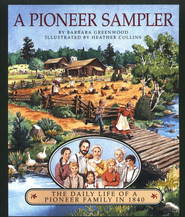
We hadn't finished A Pioneer Sampler during our early pioneers unit study, so we've continued to read it. As we read the story about pioneers finding and harvesting honey from a bee tree, I remembered that we had library books about bees for our insect unit. We read one of them, Brilliant Bees by Linda Glaser. Later, we watched several videos on YouTube about how bees make honey, and how they use the fascinating waggle dance to communicate with other bees about where food is. Here is another one we'll watch soon: Why Do Honey Bees Dance? and one for young children: Do the Waggle Dance.

Weekly worksheet packet: 


Because we spend a lot of time in the van and in waiting rooms, I like to bring schoolwork along to make the most of our time. Until today, we would lug a heavy tote bag full of workbooks that she wanted to use, and I worried about her leaving an important one behind somewhere. So today I took a three-prong vinyl folder and created a worksheet packet for her. I took a week's worth of pages from each of her workbooks – math, grammar, spelling, reading comprehension, and science – and fastened them into the folder. If she loses it, at least it's not the whole workbook. At the end of the week, I'll take out what's she's finished (unless it's needed as reference for a future page) and put in a fresh batch of pages. It also gives her a goal to accomplish, and now she doesn't have to get out several workbooks every day. Whether we are at home or away, she just needs to grab her red folder.

Art supplies: 


I recently bought a set of 36 Pentel oil pastels and a sketch book for Melody. Her artist sister is going to teach her how to use them properly very soon to create more realistic art than with crayons. In the meantime, she's been having fun making her own pictures. She likes to think of a category – fruits, things you find at a movie theater, etc. - and then draw several items on a page. I have been trying to teach myself chalkboard art. When I was working on a larger board that I had just purchased, I let her practice on a smaller one. She picked what she wanted to say: "Love one another with all your heart"! You can see my latest piece at Blessed Are the Peacemakers.


Role play: 

Melody is really imaginative and often dresses up, gathers props, and makes believe she is a movie director, a Chic-Fil-A worker, a teacher, a cooking show hostess, or whatever else her heart desires. I encourage this! It's not a waste of her educational time. She is creating her own scenarios and dialog, and is a form of oral composition. Check out her hilarious "Cream Cheese Toast" YouTube video that she made two years ago with my iPod, when she was only seven! She ends with "Like this video, or just like me! Press the suffocate button, or I'll be watching you!" Yes, that's another way to use YouTube - make your own videos!


What are some of your favorite methods for home schooling your kids? Tell us in a comment below!

Related posts:

This article link just appeared in my blog feed: Ten Obvious Truths About Educating Kids that Keep Getting Ignored. So many of these have played into the way I try to educate my little one!

And another one from a Facebook link today! On-going Education: 12 Tools I Really Dig by Tsh Oxenreider

Virginia Knowles
www.StartWellHomeSchool.blogspot.com

Saturday, January 31, 2015

A Week of Home School Third Grade


A Week of Home School Third Grade

[Please note: This post contains affiliate links from Christian Book Distributors.]

A week of home schooling my active third grader often goes by like a blur. This week was no exception. Her question every day is, “Where are we going today?” So as usual we were out and about a good bit. She's pretty alert, and captured the picture of this egret while we were running errands one day.


I look back and think about what we accomplished in each subject:

Math:

We stopped using the Horizons workbook before Christmas since it was moving too fast for her. It assumed she had all her multiplication tables down, and there wasn't much sense in continuing with it until she did. I decided then to focus primarily on the multiplication facts, and switch to a math workshop approach with a variety of activities. So as this week started, we were using:
  • flash cards
  • oral practice (in the van)
  • on-line math activities such as IXL and Math Playground
  • Math Fact Master arithmetic app on my iPod
  • Horizons supplemental worksheets
  • best of all, a Multiplication Rap DVD that I bought a few weeks ago at Lakeshore Learning


On Thursday we were in Books-A-Million and she asked me if they had anything for math. I bought the Spectrum Math Grade 3 workbook since it is not heavy on multiplication, and will give her the opportunity to maintain her other math skills like multi-digit addition and subtraction with regrouping. I also just ordered her a new JLab tablet on sale (her old Asus broke) so we'll be downloading some math apps for that.


Language Arts:

She has several language arts workbooks, but the ones we used this week were Daily Grams 3rd Grade and Nonfiction Comprehension. When we bought the math workbook, we also got the Spectrum Spelling Grade 3. We already had the Spectrum Word Study and Phonics workbook (free from a church rummage sale), but I think she needs more targeted help with spelling instead of that.

We took turns reading books out loud every day and often in the evening. We brought books along to our therapy appointments on Wednesday to read while we waited. One night she read me a bedtime story until I fell asleep! A few times she gave me oral narrations of what we had read. As we read, we pointed out homophones, compound words, proper nouns, and other grammar concepts. We also discussed synonyms and antonyms.


Life Skills:

On Monday, we decided to take a little extra effort planning dinner meals for the week. Leafing through recipe books was a lot of fun for her. She wrote down what we intended to make each night, and we discussed how to balance out the meat entrees and side dishes. Then we decided what ingredients we needed and wrote out a shopping list. It was all out of order, so we rewrote it according to grocery aisles. I reminded her to use more legible handwriting, which took a few tries. Then we went shopping, looked at nutrition labels and unit pricing, and talked about how to choose the best products.

On Tuesday and Thursday afternoons, her baby nephew came to visit. She couldn't touch him since she had just gotten over a case of impetigo, so she did a little puppet show and sang songs for him instead.


On Thursday, we shopped on-line for a new tablet for her. We read reviews and compared features before we picked one.

Since we will be flying to Maryland next week, and she doesn't remember her one air trip as a baby, we prepared a little by reading the book If You Were a Pilot by Virginia Schomp. Also in the career realm, she picked out A Day in the Life of a Musician by Linda Hayward.

History and Science:

Our current unit study is on early pioneers and farming, though we don't confine our reading strictly to that. We have also been reading biographies and short stories about notable women of the 19th century, such as author Louisa May Alcott, teacher Ann Sullivan, and first female physician Elizabeth Blackwell.

We tried starting Caddie Woodlawn a few weeks ago (see my free study guide), but didn't get too far with that yet. I had hoped to be done with this unit by now, but we've still got a lot of great books to finish. My goal is to have at least the library books read before we go out of town next week. I will save Laura Ingalls Wilder's Little House series for after we study the Civil War.

A Pioneer Sampler: The Daily Life of a Pioneer Family in 1840  -     By: Barbara Greenwood
Here is a sampling of the many history and science titles we read (all or part) this week:
  • A Pioneer Sampler: The Daily Life of a Pioneer Family in 1840 by Barbara Greenwood (my favorite resource for this unit - part fiction, with lots of factual and practical sidebars)
  • The Bears on Hemlock Mountain by Alice Dalgliesh – an easy and fun read
  • A is for Abigail: An Almanac of Amazing American Women by Lynn Cheney (wife of Dick Cheney, VP under G.W. Bush)
  • Hooray for Beekeeping! and Hooray for Sheep Farming! published by Bobbie Kalman – great for science!
  • Pioneer Bear by Joan Sandin
  • Westward Ho! The Story of the Pioneers by Lucille Recht Penner (Landmark Picture)
  • An American Pioneer Family – How They Lived by Robin May
  • The Value of Friendship: The Story of Jane Addams by Ann Donegan Johnson – the story of the Hull House settlement house in Chicago is one of my favorites, and Addams is a wonderful role model of justice and mercy


On Monday, we went to Brightlight, my favorite used bookstore. I had about $30 store credit, and we blew it all on books and a DVD for her. 


Some of the books
from Brightlight
Among other titles, I bought A is for Abigail: An Almanac of Amazing American Women by Lynn Cheney, Kirsten Learns a Lesson (American Girl book for our current unit study), Dust for Dinner (an easy reader on the dust bowl for a later unit study), and Kit Kittredge (American Girl DVD on the Depression Era). She watched the DVD that afternoon, and I watched it with her the next day. Very educational!


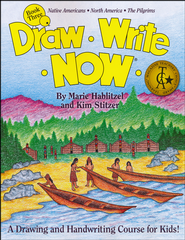
Draw Write Now, Book 3: Native Americans, North America, The  Pilgrims  -     By: Marie Hablitzel, Kim Stitzer
On Tuesday, we pulled out some easy drawing books to sketch farm animals and Native Americans. One was Draw Write Now Book 3: Native Americans, North America, the Pilgrims.


On Thursday, while waiting for my iPod battery replacement, we went to the nearby Adjectives Market antique and art store. The two floors are full of historical and beautiful things, so it made a great impromptu field trip for an hour. How vintage typewriters worked definitely piqued her interest.


On Friday morning, I remembered getting an e-mail about a Civil War reenactment about 25 miles from here. Prior to the main weekend events and full battles, they were having a home school day with some of the historical exhibits and cannon firing. Though I wasn't feeling very well, we decided to go on the spur of the moment. We arrived late but still had plenty of time to see what was there and to visit with friends we had called to join us. 

Cannon fired
(no live ammo - flour mixed with the
gunpowder made the "smoke")


Our friends with a reenactor

Here we are!

Jacob's Ladder at the toy table

Wood working booth
Fry bread and lemonade -
the perfect end to the day


That's the main stuff we did for school this week! What does your typical week look like?

Virginia Knowles

Related Posts with Thumbnails