Pages

Showing posts with label Common Sense Excellence. Show all posts

Tuesday, January 29, 2013

Home School Day in the Life (2nd, 6th, 8th & 10th Grades)


Hello!

My name is Virginia Knowles, and welcome to my Home School Day in the Life!   I'm linking up to Simple Home School's blog party on Friday. That's my big family in the picture above, including sons-in-law and grandsons, but I'm only home schooling four kids this year.


While you're here, take a peek at my free e-books on home schooling: The Real Life Home School Mom: It's a Life in ReVision <and> Common Sense Excellence: Faith-Filled Home Education for Preschool to 5th Grade (newly updated).  I also have five other blogs, www.VirginiaKnowles.blogspot.com, www.ComeWearyMoms.blogspot.com, www.ContinueWellHomeSchool.blogspot.com (middle school), www.FinishWellHomeSchool.blogspot.com (high school and beyond) and www.WatchTheShepherd.blogspot.com.  If you would like to subscribe to my monthly-ish e-magazine, you can send any e-mail to hopechest-subscribe@associate.com.

This year, we are home schooling sons in 10th and 8th grades and daughters in 6th and 2nd grades.  We also have a 4th grade son in public school, a 12th grade daughter who is dual enrolling in a two year college as well as taking Florida Virtual School courses on-line, two other adult daughters who are university students but living at home, and two adult daughters who are married.  One of them has two young sons, and we're glad they live nearby.  We have been home schooling for over 20 years.  I say "we" instead of "I" because my husband has been an integral part of the educational process, especially in the upper grades and with paper work.  That paternal participation will have to be adjusted starting next week as he starts a full-time office job across town after working from home for over 10 years.

Our typical schedule varies by day of the week.  

On Mondays, we are in co-op classes from 9 AM until 3:45 PM.  The students have 90 minute classes in math, history, science, and English.  I assist in a 4th-6th grade history class and teach 5th-6th grade English.  I have to set aside several hours a week for lesson planning for the English class, where I cover grammar, literature, creative writing, and vocabulary/spelling.  While I use a variety of materials, our core resource this year is The Book of Virtues, which is a virtual virtuous treasury of stories and poems. I try to integrate many of the literature lessons with the time period and geographical region they are studying in The Mystery of History Volume 2 (Creation to Middle Ages) text they are using in history.   After our regular classes, we stay for Yearbook (10th grade) and Drama Club (6th grade), up to an extra 45 minutes.  We have been in this co-op with about 25 other families since 2006, with one year off.   

On Tuesdays - Fridays, our morning schedule for the five younger school age kids and I looks like this:

Around 7:30, I get up, eat breakfast, take a shower, and putter around, usually either reading or writing blogs. Our son who attends public school leaves before 8 and eats breakfast at school.  Sometimes I am up earlier if I can't sleep.

At 8:30, the other kids get up, eat breakfast, and get dressed while I continue to putter.

At 9:00, I spend an hour with my 2nd grader doing her co-op assignments (which are not that time-consuming) and reading good books to her.  Right now we are working our way through the Paddington Bear series.  She's great for a cuddle on the couch.

At 10:00, I spend an hour with my 6th grader doing history and literature.  It goes faster if we read it out loud and discuss it.  She writes out summaries of the history lessons every day, but we do the literature questions orally.  She does the writing assignments, language arts workbooks, science (Apologia Flying Creatures), and math on her own time with minimal help from me.  She's pretty spunky, and always a delight.

At 11:00, I spend more than an hour with my 10th grader doing history (Notgrass World History) and literature (just finished The Hobbit and now starting poetry).  He usually reads the chapters aloud to me, we discuss them, and he answers the comprehension questions orally or on the computer.  I have learned so much world history and classic literature this year!  I am so thankful for the opportunity to study along this way with my son, and I know he appreciates it, too.  My husband is in charge of his Algebra 2 and Apologia Chemistry assignments.

You may notice that I didn't schedule an hour for my 8th grade son.  He is a reliable independent learner and doesn't often need my help, though he asks for it when he does.  He's also really creative, so even most of his free time is spent learning, whether it is special effects video editing or nature study or whatever. My husband helps him with Pre-Algebra and Apologia Biology.

Around noon or so we eat lunch.  Usually everyone fixes their own, but my 12 year old daughter will sometimes fix something like macaroni and cheese for all of us.

Our afternoon/evening schedule is a bit more loose.  Yes, we work on academic school assignments until around 3 or so.  They also spend a lot of time on our computers and some watching TV. However, we are trying to get into a routine of going to the YMCA on Tuesday and Friday right after lunch, especially since they have home school PE on Tuesday.  We have to be home by the time my 4th grader gets back from school. I try to schedule all appointments for Thursday afternoons.  

Somewhere along the way the laundry and dishes get done (or not!) by some combination of adults and kids. Each of the five younger kids does an afternoon dish load during the week, and there is always a second or even third load in the evening.  Though we have basic organization for each room, we do tend to leave it a bit cluttered, especially with school books and papers.  Then, too, our big family has this funny little habit of eating lots of food, so it seems I'm at the grocery store two or three times a week refueling milk and such.


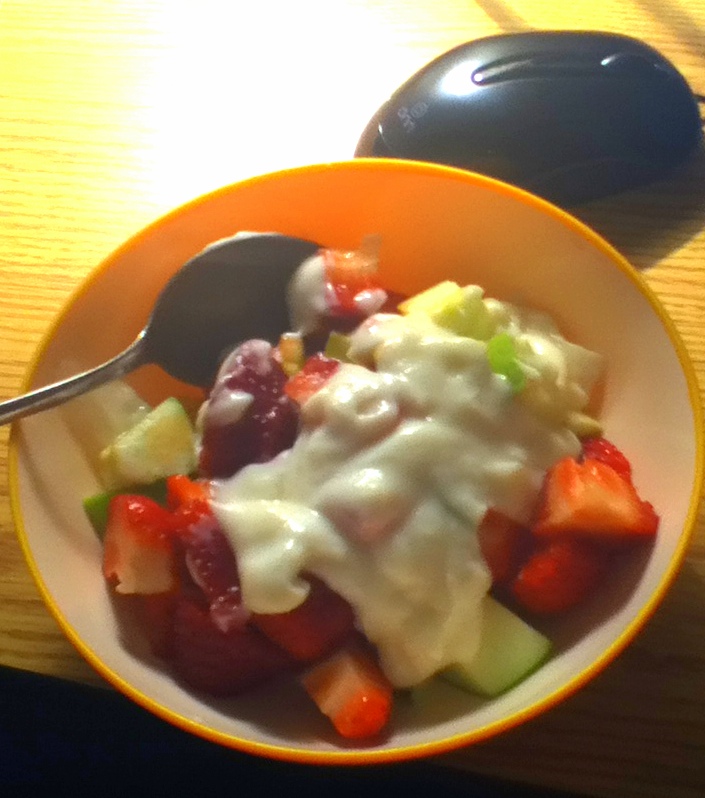
Speaking of food, I now interrupt this blog post because my 8th grade son just brought me a big bowl of fresh fruit salad with vanilla yogurt.  Yum.

Dinner is usually around 6:30, and after that we have free time, clean up, or more school work if not enough of that got finished earlier.  (I often help kids with school work in the evening and on weekends.)   The kids go to bed sometime between 9 PM and midnight, depending on their age and if something exciting is happening or not. 

So that's how we supposedly spend our days.  It rarely works out just like that, but you get the gist of it anyway.

You might also like a related post I wrote this morning: 

Who is the Proverbs 31 Woman? Not Me Yet!


What is your home school day like?

Virginia Knowles
www.StartWellHomeSchool.blogspot.com

P.S. This post will be linked at these other blog parties:


P.P.S. In case you missed my e-book, e-magazine and blog links at the top of this post, here's the rehash...

E-Books:


Blogs:
E-magazine:

Saturday, April 14, 2012

How to Plan a Unit Study


HOW TO PLAN A UNIT STUDY
by Virginia Knowles
from


What is a Unit Study?
Steps for Planning a Unit Study
Long Range Planning
Unit Study Topic List

WHAT IS A UNIT STUDY?

Unit study is a natural common sense excellence method of learning in which you choose a theme, and then incorporate various school subjects, such as literature, language arts skills,  history, geography, careers, science, technology, art, music, and math application.  There is a  logical connection between subjects.  They all fit together naturally, just like in the real world. 

Each unit study is different.  Some unit studies concentrate primarily on one subject (history, science, etc.) with the others tucked in.  Some are based on holidays or family trips. Some are more activity-oriented, while others are book-based, depending on the topic and your teaching style.  You can design your own unit study plan, buy a package or guide, or borrow from a friend.  Unit studies can take a few days, week, month, or year. You could do them all year or just once in a while.  You can plan several at a time or do one spontaneously based on a question or interest from your child.  Don't get bogged down in details.  If a unit study bombs, you learn how not to do one the next time. 

A unit study doesn’t have to be elaborate. It can be as simple as going to the library and checking out a few books.  Find what style suits you.  Don't be discouraged if you are not creative or organized.  You don't have to plan a whole year of unit studies ahead of time, or overload on creative activities in each one.

A unit study can include more than one child, but individual attention is still needed.  One goal of unit studies is to build family unity and save mom's planning efforts, but you still need to spend separate time on language arts and math at each child's level.  It may be helpful to plan one time of day for skills curriculum (phonics, grammar, punctuation, math, music theory, etc.) and then another time slot for content curriculum (unit studies covering history, literature, science, art appreciation, etc.) 

Social studies and science themes can be closely integrated.  Human culture and the physical world affect each other.  People discover scientific principles and then act them out in history.   When we studied Ancient Egypt, a history theme, we learned science too: how a mummy is made, how pyramids were built without machines, and how land was irrigated.  In our next unit, we studied the entire desert habitat, including biology (plants and animals), geology (sand dunes), weather (rain patterns), geography (comparing deserts around the world), history (archaeologists), and sociology (Native Americans, African nomads).  Social studies and science emphases can be alternated and intertwined.  

Language arts and math can be incorporated into unit studies.  Research and literature count as reading. Spelling and vocabulary lists, creative writing projects, and dictation selections, and math word problems can complement the unit study.


A Page from a 3rd Grade Notebook

Spelling List about Mexico 
  • Mexico
  • Central America
  • Maya
  • Aztec
  • pyramid
  • temple
  • solar calendar
  • weave                           
  • cotton
  • vanilla
  • chocolate
  • jungle        

STEPS FOR PLANNING A UNIT STUDY

TOPIC AND TIME AVAILABLE:  Pick a topic which is interesting to your children, and which incorporates several school subjects.  Whatever you choose, your child should:   hypothesize, integrate related information, analyze, research, read, write, etc.  How much time you can spend determines how specific you can get with your topic. You could cover flowers in a week, but botany could easily take a month.  Children usually start to lose interest after about three or four weeks of concentrated study on a topic; don’t frustrate them with overkill.

SUB-TOPICS AND SCHOOL SUBJECTS: Make a list of sub-topics for your theme.  A study of the Middle Ages could include castles, knights and weaponry, the Crusades, Vikings and their ships, famous kings, peasant life, food and clothing, fairy tales, etc.  As you list the sub-topics, integrate various school subjects such as: Bible, scientific principle, experiments, technology, nature study, history, geography, government, careers, language skills, literature, creative writing, math application, art, music, life skills, etc. 

OBJECTIVES: Write specific goals of what you want your child to understand by the end of this unit.  You won't learn everything, but you should attempt to lay a framework for future learning and whet their appetites to explore more on their own. 

LEARNING MODES: Adapt activities to your children. Cater to their learning styles, whether visual, auditory, kinesthetic/tactile, etc.  Use a variety of approaches to help lock in the material from many angles.  Consider each of your children when you do this planning.   Be sure to ask them for ideas about what they would like to do for this unit study, because children can be chock full of great ideas.  It also gives them a sense of being included and being important!

AGE LEVELS: Preschool and kindergarten children especially like picture books, fun songs, coloring, and make-believe.  Primary grade children can read books, write a little, draw pictures, make crafts, and do simple experiments. Older students can research, write papers, create independent projects, and wrestle with issues and current events. Choose some books to read to all of your children and then give age-appropriate activities to each child, with older doing more than younger. Older children can occasionally help younger children by reading to them, assisting with projects, and answering questions.

RESOURCES: List what you already have: books, encyclopedia articles, videos, music, magazines, recipes, instructions, pictures, craft and experiment supplies, web sites and phone numbers to call for more information.  Include titles, authors and page numbers so you can easily make assignments.  Check the indexes of any poetry or story anthologies you may own.  Write down what you will need, and where you might find it. Make games, worksheets, and pictures.  Plan purchases and order in time.

SCHEDULE: Map out a tentative schedule.  What will you do each day?  How much will you cover in a week?  For a three-week unit, you could tackle one major sub-topic each week.  You might need to raid the library first and refine your day-by-day plan based on your selections.  Vary activities from day to day to prevent boredom.  Start with the simple and work towards the complex.  Plan buffer time and decide which activities are optional so you'll know what to skip in a crunch.  Check newspaper and magazine calendars for field trip ideas.

LONG RANGE PLANNING

Several years ago, as I was looking to the future of our home education program, I decided that we needed a plan so that we could learn about various topics and school subjects in a reasonable manner.  From those early brainstorms hatched the idea for a quasi-comprehensive list of 60 three-week unit studies to be covered in five years.  We successfully finished the units in our list a couple of years ago, and we’ve gone on to other schemes since then.  An adapted version of our unit study list is included here, and is organized by school subject, rather than the sequence our own family did them.  This purpose of this list is just to give you an idea of how things can fit together in a long range plan, even if you don’t decide to do a sequenced series of units.  For example, you could study history chronologically and continually (without breaking it up into separate units), cover one continent all throughout the year, and layer various science, technology, and health topics on top of whatever history and geography you are studying at the moment.  (This is what we’ve been doing for the past two years.  It works.) Please note that the “Spiritual Emphasis” listed for each year is not a separate unit, but an overall theme for the year.
 UNIT STUDY TOPIC LIST

YEAR 1
  • History: Old Testament, Ancient Egypt, Ancient Greece
  • Geography: Africa
  • Science: Creation Week, Weather, Life in the Desert
  • Health: Babies and Family Life
  • Technology & Trade: Books and Publishing
  • Spiritual Emphasis: Old Testament

YEAR 2
  • History: Ancient Rome, Life and Times of Christ, Early Church, Viking Times
  • Geography: Ancient and Modern Asia
  • Science: Farm Life, Chemistry, Animal Classification
  • Health: Human Body
  • Technology & Trade: Buildings (Homes, Construction, Architecture)
  • Spiritual Emphasis: New Testament Church and World Missions

YEAR 3
  • History: Middle Ages, Renaissance, Reformation, Explorers, Art & Music History
  • Geography: Europe, Land Forms, Maps & Globes
  • Science: Physical Science, Life in the Water, Plant Life
  • Health: Nutrition & Exercise
  • Technology & Trade: Ships, Musical Instruments
  • Spiritual Emphasis: Reformation of the Church

YEAR 4:
  • History: 17th-19th Century History (U.S.A.: Pilgrims, Colonial, Patriot, Pioneer, Civil War)
  • Geography: North and South America
  • Science: Life in the Forest, Birds
  • Health: Medicine & Health Care
  • Technology & Trade: Inventions & Modern Manufacturing, Communications
  • Spiritual Emphasis : Liberty and Justice

YEAR 5:
  • History: Regional History (State/Province), 20th Century, World Wars, Life in the Future
  • Geography: Regional Geography, Middle East, Australia
  • Science: Insects, Flowers, Astronomy
  • Health: General Health
  • Technology & Trade: Aviation, Space Travel, Energy, Economics
  • Spiritual Emphasis : Spiritual Growth
&

“The more I study nature, the more I stand amazed at the work of the Creator. 
Into his tiniest creatures, God has placed extraordinary properties.”
Louis Pasteur (1822-1895), the French scientist who developed process of pasteurization for milk, as well as vaccines for anthrax and rabies


1-2-3 Ideas to Remember about
Teaching with Unit Studies

  1 Keep unit studies simple!  Don’t feel overwhelmed!

  2    Integrate many school subjects in a natural way.

  3    Plan spontaneously or long-term.


Other unit study posts on this blog:

Thursday, April 5, 2012

Your Children Can Help with Meal Times


Dear friends,

I'm doing a Hope Chest e-magazine issue on Food & Compassion, and thought I'd include a section I wrote on Meal Times in my book Common Sense Excellence: Faith-Filled Home Education for Preschool to 5th Grade.  This excerpt is from the chapter on Life Skills.


MEAL TIMES

“In the house of the wise are stores of choice food and oil, 
but a foolish man devours all he has.”  Proverbs 21:20

“Better a meal of vegetables where there is love than a fattened calf with hatred.” Proverbs 15:17

“She is like the merchant ships, bringing her food from afar.  
She gets up while it is still dark;
she provides food for her family and portions for her servant girls.” 
Proverbs 31:14-15

The way to a man’s heart is still through his stomach.  Jesus fed bread and fish to the hungry multitudes, called himself “the bread of life”, ate a communion meal in the Upper Room with his disciples just before he was betrayed, and even ministered to them after his resurrection by roasting fish for them on the shore.  At this time, he also admonished the apostle Peter to “Feed my sheep.”  (See John 21.)  Can you just imagine the Wedding Feast we will enjoy in Heaven with Jesus as our Bridegroom?  If meals are so important in God’s sight, I think they should be a vital part of our children’s life skills education!   Here are some things you can teach your child to do:

Check out cookbooks from the library in the j651 section.  You will find plenty of international and historical food books, such as those listed in the Social Studies section.    The Fannie Farmer Junior Cookbook is one of our general favorites 

Start a recipe collection.  Let your child start a recipe notebook or box to collect her favorites.  These might include family recipes that are passed down from relatives. Take care that recipes are copied accurately!  If you like, you can insert each page into a plastic notebook sleeve to keep it clean during use. An older child can also choose one recipe to learn very well so that it can be her specialty.   She can also experiment with how to adapt recipes to make them healthier or more unique. My daughter Mary made her own illustrated keepsake cookbook when she was in elementary school. 

Plan a weekly menu, fill out a shopping list, go to the grocery store and shop for the ingredients.  Learn how to find the best quality and price for foods.  Read nutritional labels and unit pricing. While you are at the store, browse through unusual foreign foods such as calabaza, yucca root or malanga.

Follow recipes and learn the lingo. How much is a pinch of salt?  What does it mean to dice, mash, or simmer food?  Memorize abbreviations such as t. or tsp. for teaspoon and T. or Tbs. for tablespoon so that you don’t mix them up. 

Practice using kitchen utensils and appliances safely.  This might include the microwave oven, popcorn air popper, hand mixer, stove, apple corer, etc.

Prepare the food. Cut foods with a safe knife, peel vegetables, measure ingredients, mix batters, tear up lettuce for a salad, put spreads on bread, assemble a sandwich or burritos, spoon out dough for drop cookies, decorate a cake, scramble eggs, boil water for noodles, etc.

Learn about timing various elements of the meal preparation.  Your child will learn how to plan ahead so that everything is done and hot at about the same time. This requires more advanced thinking skills.  What will go on the big burners on the stove top?  If two things need to go in the oven, will they require the same temperature?  Will they both fit? What can be kept warm without burning?  What productive things can you do in the kitchen while you wait for the meat to fry?

Serve food to the table without dropping it.  Use plastic plates until your child gets the hang of this.  This requires walking steadily, and perhaps using a tray. 

Pour drinks without spilling.  Practice this with water over a sink or counter first. Use a child-friendly pitcher.  Allow your child to serve drinks to family members who are working outside in hot weather.

Clean up!  Don’t neglect this part of the process, or you will pay for it in aggravation later. Even a two year old can carry a plastic cereal bowl to the sink, stand up on tiptoe and dump it in.  A four year old can scrape his plate into the garbage -- after he eats his vegetables!

Pack a picnic lunch.  Plan which foods can “keep” safely outside and are tidy to eat. Learn how to pack them so they won’t spill or spoil.  Include unbreakable plastic or paper plates and cups, as well as a good supply of napkins.

Explore food careers through books and field trips. What is it like to be a dietitian, chef, restaurant owner, or caterer?  What kind of laws govern food safety in restaurants or stores?

Learn table manners. There are courteous ways to eat, pass items, be excused, remove something inedible from your mouth, etc. Ask God’s blessing on the food. Memorize a variety of traditional table graces, and be able to ask a spontaneous blessing.

~*~*~

I hope you have enjoyed this excerpt!  There are a lot of links about food on my other blogs, www.virginiaknowles.blogspot.com and www.comewearymoms.blogspot.com.  I've been doing a series on saving money, menu planning, etc.

Also on this blog: My Own Batch of Cookies

Virginia Knowles

Wednesday, January 11, 2012

Oral Language Learning for Young Children


My youngest daughter and my grandson

Dear friends,

Here's an excerpt from my book Common Sense Excellence on teaching oral language. This includes listening, speech, and oral composition.  Oral language is something we teach throughout the day with our little conversations, whether we realize it or not.  Brothers and sisters even learn it from one another!  Oral language is the vital preparation for learning to read and write.


ORAL LANGUAGE

Listening

“Come, my children, listen to me; 
I will teach you the fear of the LORD.” Psalm 34:11

“...let the wise listen and add to their learning, 
and let the discerning get guidance.” Proverbs 1:5

“Pay attention and listen to the sayings of the wise; 
apply your heart to what I teach, 
for it is pleasing when you keep them in your heart 
and have all of them ready on your lips.” 
Proverbs 22:17-18

Listening to spoken words is where it all begins!  Our children listen to us talk from the time they are in our wombs.  We don’t give them formal lessons, but they learn to talk anyway. Isn’t it amazing?

Take full advantage of the power of warm companionship.  The constant give and take of conversation, coupled with the natural repetition in everyday life, enhances listening skills almost effortlessly. Encourage your young children to tell you about their feelings and the events of the day.  And listen to them!  Be interested! 

Discern auditory problems. Does your child seem to have a hard time listening to you?  There is a difference between hearing and listening.  Your child may seem to be merely uncooperative, but perhaps he can’t hear you well enough to distinguish sounds properly.  Because hearing impairment affects the ability to process language, this can lead to permanent speech delays, so please don’t ignore this possibility. Many auditory and speech problems can be detected by a doctor or speech/language therapist using simple screening tests. If money is a concern, check with your county health department or local public school for free or low-cost testing and/or therapy.

Teach your child to pay attention. Suppose your child can hear you just fine -- when he wants to!  Perhaps he needs extra practical training in the fine art of listening.  Maybe it’s an attitude problem, but it could be that he just doesn’t know how to listen.  First, make sure that he is right in front of you, not across the room or at the other end of the house.  Next, make sustained eye contact. The ability to look someone in the eye as they speak is a valuable skill, and we may as well start now!  When your child is “front and center” paying attention to you, start talking to him.  Keep the sentences short, sweet and specific.  Ask him to repeat after you what you said.  Does he know what you mean?  If you say, “Please clean your room,” does he interpret that as an option because you said “please” or does he understand it as polite but mandatory?  Exactly what does “clean” mean?  Oh, and is there any time limit on this assignment?  Spell it out!  Then check up on it!
 
Work on simple auditory memorization skills. A valuable language skill is to be able to store the “input” in such a way as to recall it for “output” later.  As part of our listening skills approach, we encourage our young children to memorize Scripture passages, poetry, song lyrics, and quite pragmatically, a sequence of instructions that we wish them to follow.  Start small, and go slow.  Give them a phrase or two at a time, and repeat that until it is learned.   When you start using dictation methods for academics (more on this later), you will appreciate the time you have spent developing auditory memory.  Remember that it is better for them to memorize a few things thoroughly than many things shakily.  

Practice rhyming words.  Tell your child several examples of rhyming words, such as cat and mat or nickle and pickle.   Then say pairs of words (some rhyming and some not) and ask your child if they rhyme.  Next, say a word and ask your child to give you one that rhymes it. This may sound silly, but rhyming is an effective auditory discrimination activity and pre-reading skill.

Match spoken words with visual images. In the beginning stages, you can point to a picture and name it for your child.  When he knows many of the words, you can point to a picture and ask him to name it, or you can name an item and ask him to point to it.  (This is an example of Dr. Maria Montessori’s Three-Period Lesson.)  This activity naturally provides for continued discussion about the things you see on each page of a picture book.  For example, you can talk about shapes and colors of items, their uses, and other educational concepts -- all cuddled up on the couch having a grand time!

Speech

Moses said to the LORD, 
‘O Lord, I have never been eloquent,
neither in the past nor since you have spoken to your servant. 
I am slow of speech and tongue.’  
The LORD said to him, ‘Who gave man his mouth? 
Who makes him deaf or mute? 
Who gives him sight or makes him blind? 
Is it not I, the LORD?
Now go; I will help you speak and will teach you what to say.’"  
Exodus 4:10-11

“Before a word is on my tongue you know it completely, O LORD.” Psalm 139:4

“Pleasant words are a honeycomb, sweet to the soul and healing to the bones.” Proverbs 16:24

Coach your children on how to control their voices.  Proper volume, tone, pitch, inflection and speed will make them pleasant to hear. They should know when a quieter “inside” voice is appropriate, and when it’s OK to be more exuberant.  For example, if they are visiting someone who is wearing a hearing aid, they need to be sensitive to the fact that loud noises might cause a very unpleasant screeching noise in the person’s ear.  Start early to teach your children to control their voices!

Discuss when to speak and when to be quiet.  Do you have a little chatterbox who won’t let anyone else get a word in edgewise?  Teach her how to take turns in a conversation!  There are also times when we have to be totally quiet.  In most church services, it is important to be silent during the pastor’s prayer and sermon.  However, we should sing out enthusiastically during a rousing praise chorus, and greet others in a normal conversational tone (not a shy whisper!) during the “meet your neighbor” moment.  Part of this will come by your example, but you will probably also need to issue some gentle reminders when the actual time comes. 

Work on correct pronunciation and diction.  You may be able to understand what your child is saying because you know him and can practically read his mind, but can other people figure out his speech?  Some pronunciation problems are developmental, which means that the child usually grows out of it with time and practice.  The ability to correctly pronounce the R sound, for example, often does not appear until age seven.  Work with your child gradually, practicing sounds with him as you read stories, learn nursery rhymes and carry on simple conversations.  Try not to call undue attention to the problem; nervousness tends to make it worse.  Consult a physician if you suspect a physical problem, such as a tight connecting tissue under the tongue.   A speech therapist can also help diagnose and treat problems.  If you can’t afford to see one in private practice, ask for a free screening with a public school therapist.  Your child, even as a preschooler, may be eligible for special education sessions.    I had a speech impairment until minor surgery at age seven, and two of my children have had significant speech delays and/or diction problems which eventually improved, so my full sympathies are with you!

Let your child play with accents. This is the beginning of drama!  Some of the easiest accents to imitate are Southern USA, Boston, New York, British, Australian and Spanish. In the process, children learn to listen carefully to what makes each one distinct, and to reproduce the sound patterns not just in a given word, but in a whole spontaneous conversation.  Can you hear the gears clicking in their brains?

Show how the meaning of a word or sentence can change with tone of voice or vocal inflection.  Try changing your tone of voice (jovial, haughty, sad, excited, mildly sarcastic, serene) or emphasize different words in the sentence.  How does this change the message that comes across?

Teach your child how to answer the phone correctly, as well as make outgoing calls.  This will vary from family to family, but instruction should include what to say when you answer the phone, how to inform a family member that they have a phone call, what to say if the person they ask for is not available, how to take a message, how to dial a number, how to leave a message, what hours are appropriate for phone calls, etc.  I often remind my children that if they make a comment in the earshot of someone here who is on the phone, the person on the other end can probably hear it, too.

Practice reciting short pieces of literature.   Poems and famous speeches are good material for this activity.  Recitation helps a child to speak clearly and expressively, to cut out dead words such as um and you know, and to control his body movements.  Do this in the privacy of your own home until your child is ready for a more public audience.

Accustom your child to public speaking situations.   As ambassadors for Christ  Jesus, it is so helpful to be able to get up in front of a crowd and say a few intelligible words without fainting!  Start with a simple recitation, and move up to more original presentations.

Train your children to speak sweetly to each other and to you.  If I had it all to do over again, I would have majored on this.  I can tell you from experience that if you fail in this area when your children are young, you will pay for it later.  Name calling, bickering, tattling, slander, whining, sassing -- these can all poison the atmosphere of your home to the extent that you allow them.  Once ingrained, they are hard to shake off.  You can help your child find ways to communicate his feelings which do not tear other people down and stir up conflict.  This includes tone of voice, body language, and actual words.

Oral Composition

“Jesus spoke all these things to the crowd in parables; 
he did not say anything to them without using a parable. 
So was fulfilled what was spoken through the prophet: 
‘I will open my mouth in parables, 
I will utter things hidden since the creation of the world.’”  
Matthew 13:34-35

“Listen, for I have worthy things to say; 
I open my lips to speak what is right.” Proverbs 8:6

“Gold there is, and rubies in abundance,
but lips that speak knowledge are a rare jewel.” Proverbs 20:15

Moving beyond the mechanical aspects of listening and speaking, I would like to talk about something which requires a little more brain power: oral composition.

Oral composition starts at birth.  The earliest exposure your child has to language formation is  hearing you speak from the time he is born.  How do you choose your words?  How do you organize your thoughts?  Can he follow the sequence of events when you tell about something that has happened, or when you make up a story just for him?  As he grows through the preschool years, he will tell you about life as he knows it, like what happened when Daddy took him to the baseball game.  It may be out of sequence a little bit, or perhaps he exaggerates here and there, but it’s his story.  Yes, this is oral composition in its seedling form.  Water it, and it will bear fruit.  Listen!

Oral composition sneaks in when your child is at play.  If she is building in the sand box, she might tell you that she is making a castle.  If he is dressing up, he might be a clown or a soldier.  If she is playing with dolls, she might speak to her babies in sentences that sound uncannily like your own (for better or worse)!   If he is racing around with a toy fire engine, he might describe how he is putting out the flames.  Talking about what he or she is doing is a vital part of the pretending process!  You can help by providing the props and asking an occasional question.

Oral composition is developed by narration.  For a more academic approach, let me elaborate on oral narration, which I mentioned in the Literature section.  Charlotte Mason advocated this method for all ages, but especially for young children.  It means telling back what you have heard in your own words, and perhaps adding in your own opinions or ideas about the topic.  This can be done after listening to a story or poem, reading a chapter of a book, or even looking at a piece of fine art.  The narration might be sprinkled with a few new vocabulary words from whatever was read.  In this way, he not only shows that he understands the material, but he is also developing his own language skills in a powerful and natural way.  These sessions can be short and sweet, perhaps just a few minutes.   If you must ask questions, try to keep them open-ended so that your child can’t just reply with a yes or no, or answer with a bare bones phrase.  You don’t want to extract the information, but let it flow.

Oral composition flows from a topic which grabs your child’s attention and interest.  Maybe you are out in the garage doing laundry when he comes up and starts chattering about an exciting book he’s been reading about snakes or astronauts or whatever.  You can tell he is psyched about it.  You know the information is rattling around in his brain, just waiting to be released through his mouth!  Let it stay at this level for quite some time, just getting him comfortable sharing verbally, either with factual information or a story. 

Oral composition blossoms into original storytelling. After a child has had ample exposure to read aloud literature and plenty of practice in oral narration, he may be ready for original oral storytelling beyond what would normally occur in conversation.  Working orally should definitely come before any attempt at formal written storytelling!  A few children may want to make up fanciful stories, but most would do well to stick with the familiar, such as a description of things they have experienced with their senses, or a narrative of a recent happening. You can easily incorporate oral storytelling naturally and spontaneously by asking your child, “Tell me all about the Christy’s birthday party!” or “Why are you so excited right now?” or “You didn’t like the way that story ended.  How would you change it?”    Keep in mind that you can use oral narration and composition with a child who does not yet know how to read.  Even a three year old can offer a few sentences here and there.  These little conversations are part of your warm and loving relationship with your child, not some complex scholarly skill!  Many years ago, our little children would beg to hear my impromptu stories about the fictional Blake family.  When I was too tired to think of anything even halfway original, Joanna, then nine, came to the rescue with her own Max and Liz stories.  After all, she has heard mine often enough that she had a pattern to go by, and she has a lively imagination of her own.  The younger ones began to prefer her stories to mine.  (I won’t take that personally!)  The older ones still tell stories to their little brothers and sisters. These story telling sessions may be after regular school hours, but I’d be the last one to complain!

Oral composition is a crucial academic skill.  Parents may discount the value of oral narration or story telling because there is no paper trail to prove that the child has done “language arts” for the day.  If this is your concern, just mark down on your child’s record sheet what he did:  “Gave oral narration about Abraham Lincoln biography,” or “Discussed Charlotte’s Web book with Mom,” or “Described paintings at art museum,” or “Made up original story about exploring Mars.”  These are all perfectly valid educational activities, and you should be proud to have them listed in your child’s portfolio. Just think of how pleased you will be when your child can carry on an interesting conversation with the adults and children at your next family reunion!
Related Posts with Thumbnails