Pages

Showing posts with label Ages and Stages. Show all posts

Thursday, May 29, 2014

My Ideal Plan for Elementary Home Education (With a Lot of Links!)


My Ideal Plan for Elementary Home Education
(With a Lot of Links!)

Honestly, when I started teaching part-time at a private school last year and my kids transitioned into more traditional classroom education, I thought my 20+ home schooling years were pretty much over. However, since I was not rehired and my youngest daughter has asked to come home from public school, I am now planning to home school her for two or three years before I transition into full-time employment.  Our last year of co-op was rather frustrating and disappointing, so this is also a chance to redeem my home schooling memories and end on a happy note. I most look forward to spending time with just her. She's gotten a little lost in the shuffle the last few years.

We both quickly decided we want to do what I did with her oldest five sisters (now adults) when they were in the upper elementary grades.  My favorite approach for 3rd-5th grades is a good mix of unit study and Charlotte Mason style, along with a little “traditional” school and free-spirited fun.  I am taking a few things into account as I customize her education.  
  • She is extremely curious and creative, so I don’t want to quench the spark in her. On the other hand, we both have attention deficit issues, so we’ve got some work to do with basic habits, organization, and following directions.  I held her back a year already (August birthday), so we really need to nail these skills.  She is not a huge fan of workbooks or formal text books, and neither am I; hence the Charlotte Mason approach of lots of real reading and real writing, the arts, history, and nature studies.
  • She will be my only student at home this year, so I can focus on just her, without trying to coordinate group and individual assignments. That will give us a bit more flexibility and spontaneity. I am looking forward to that! Teaching a bunch of kids who all need attention at the same time can really scatter the brain.  
  • She will eventually return to public school. Elementary students in our area get very little history and science instruction because they are pushing basic skills for the standardized tests. The middle school and high school classes certainly do not promote a Christian perspective, so she's going to have to get that at home from me. She never got a substantial history education in our old co-op, and she was too young for our group history lessons the one year we stayed home. Therefore, one of my big priorities will be giving her comprehensive, in-depth, faith-based history and science instruction. 


With those factors in mind, here is what we plan to use and do this year:

Basic Skills:
  • Horizons math workbook 3rd grade
  • math manipulatives
  • on-line math games
  • A Reason for Handwriting
  • The Reading Teacher’s Book of Lists (spelling and vocabulary)
  • Building Thinking Skills books
  • several grammar resources
  • chapter books that she chooses and I approve
  • writing assignments based on whatever she is studying, along with whatever zany stories she makes up 


American History:

We have dozens of non-fiction books, picture books, fiction chapter books, project books, and videos on our shelves. The year we were not in co-op, I compiled a list of them on my computer, sequenced by time periods, with page numbers, brief synopses, and reading levels. I will also use our weekly history assignment pages from that year.  See Favorite Books for Teaching American History.

Science:
  • science units on botany, zoology, and earth science using the books and videos we have on hand, as well as the Internet
  • nature walks around the neighborhood and in local parks
  • visit the Orlando Science Center once a month (I am about to get an annual family membership for $135 next week so I can take all of the kids to the IMAX movies over the summer, too.)


Other Subjects  
  • Bible - real version, picture books, and videos
  • P.E. at the co-op while I teach, as well as soccer at a local church  
  • arts and crafts on her own at the desk I just set up with art supplies in the dining room - we have a lot of drawing and craft books!
  • home skills - learn basic household skills, keep her room clean, cook together, visit her four small nephews (my grandchildren)  
  • music - sing favorite songs and American patriotic and folk songs 
  • Christmas - Advent unit study with stories, songs, poems, and crafts


(Note that I'm trying to keep it simple with this last section. I don't want to bite off more than I can chew.) 

So, there you have it! That’s what we’re doing for school for 2014-2015!

As I thought through this article, I realized that I have a lot of blog posts about the foundations of elementary education.  Here are some of my favorites:

Home Schooling Approaches


Logistics

Basic Skills


American History


Bible & Christian Holidays


Enrichment

What do you like to do for the elementary years?  Leave a comment!

Virginia Knowles

www.StartWellHomeSchool.blogspot.com


"Colorful House" by Melody, 2012 

"Rainbow" by Melody, 2012

Tuesday, January 29, 2013

Home School Day in the Life (2nd, 6th, 8th & 10th Grades)


Hello!

My name is Virginia Knowles, and welcome to my Home School Day in the Life!   I'm linking up to Simple Home School's blog party on Friday. That's my big family in the picture above, including sons-in-law and grandsons, but I'm only home schooling four kids this year.


While you're here, take a peek at my free e-books on home schooling: The Real Life Home School Mom: It's a Life in ReVision <and> Common Sense Excellence: Faith-Filled Home Education for Preschool to 5th Grade (newly updated).  I also have five other blogs, www.VirginiaKnowles.blogspot.com, www.ComeWearyMoms.blogspot.com, www.ContinueWellHomeSchool.blogspot.com (middle school), www.FinishWellHomeSchool.blogspot.com (high school and beyond) and www.WatchTheShepherd.blogspot.com.  If you would like to subscribe to my monthly-ish e-magazine, you can send any e-mail to hopechest-subscribe@associate.com.

This year, we are home schooling sons in 10th and 8th grades and daughters in 6th and 2nd grades.  We also have a 4th grade son in public school, a 12th grade daughter who is dual enrolling in a two year college as well as taking Florida Virtual School courses on-line, two other adult daughters who are university students but living at home, and two adult daughters who are married.  One of them has two young sons, and we're glad they live nearby.  We have been home schooling for over 20 years.  I say "we" instead of "I" because my husband has been an integral part of the educational process, especially in the upper grades and with paper work.  That paternal participation will have to be adjusted starting next week as he starts a full-time office job across town after working from home for over 10 years.

Our typical schedule varies by day of the week.  

On Mondays, we are in co-op classes from 9 AM until 3:45 PM.  The students have 90 minute classes in math, history, science, and English.  I assist in a 4th-6th grade history class and teach 5th-6th grade English.  I have to set aside several hours a week for lesson planning for the English class, where I cover grammar, literature, creative writing, and vocabulary/spelling.  While I use a variety of materials, our core resource this year is The Book of Virtues, which is a virtual virtuous treasury of stories and poems. I try to integrate many of the literature lessons with the time period and geographical region they are studying in The Mystery of History Volume 2 (Creation to Middle Ages) text they are using in history.   After our regular classes, we stay for Yearbook (10th grade) and Drama Club (6th grade), up to an extra 45 minutes.  We have been in this co-op with about 25 other families since 2006, with one year off.   

On Tuesdays - Fridays, our morning schedule for the five younger school age kids and I looks like this:

Around 7:30, I get up, eat breakfast, take a shower, and putter around, usually either reading or writing blogs. Our son who attends public school leaves before 8 and eats breakfast at school.  Sometimes I am up earlier if I can't sleep.

At 8:30, the other kids get up, eat breakfast, and get dressed while I continue to putter.

At 9:00, I spend an hour with my 2nd grader doing her co-op assignments (which are not that time-consuming) and reading good books to her.  Right now we are working our way through the Paddington Bear series.  She's great for a cuddle on the couch.

At 10:00, I spend an hour with my 6th grader doing history and literature.  It goes faster if we read it out loud and discuss it.  She writes out summaries of the history lessons every day, but we do the literature questions orally.  She does the writing assignments, language arts workbooks, science (Apologia Flying Creatures), and math on her own time with minimal help from me.  She's pretty spunky, and always a delight.

At 11:00, I spend more than an hour with my 10th grader doing history (Notgrass World History) and literature (just finished The Hobbit and now starting poetry).  He usually reads the chapters aloud to me, we discuss them, and he answers the comprehension questions orally or on the computer.  I have learned so much world history and classic literature this year!  I am so thankful for the opportunity to study along this way with my son, and I know he appreciates it, too.  My husband is in charge of his Algebra 2 and Apologia Chemistry assignments.

You may notice that I didn't schedule an hour for my 8th grade son.  He is a reliable independent learner and doesn't often need my help, though he asks for it when he does.  He's also really creative, so even most of his free time is spent learning, whether it is special effects video editing or nature study or whatever. My husband helps him with Pre-Algebra and Apologia Biology.

Around noon or so we eat lunch.  Usually everyone fixes their own, but my 12 year old daughter will sometimes fix something like macaroni and cheese for all of us.

Our afternoon/evening schedule is a bit more loose.  Yes, we work on academic school assignments until around 3 or so.  They also spend a lot of time on our computers and some watching TV. However, we are trying to get into a routine of going to the YMCA on Tuesday and Friday right after lunch, especially since they have home school PE on Tuesday.  We have to be home by the time my 4th grader gets back from school. I try to schedule all appointments for Thursday afternoons.  

Somewhere along the way the laundry and dishes get done (or not!) by some combination of adults and kids. Each of the five younger kids does an afternoon dish load during the week, and there is always a second or even third load in the evening.  Though we have basic organization for each room, we do tend to leave it a bit cluttered, especially with school books and papers.  Then, too, our big family has this funny little habit of eating lots of food, so it seems I'm at the grocery store two or three times a week refueling milk and such.


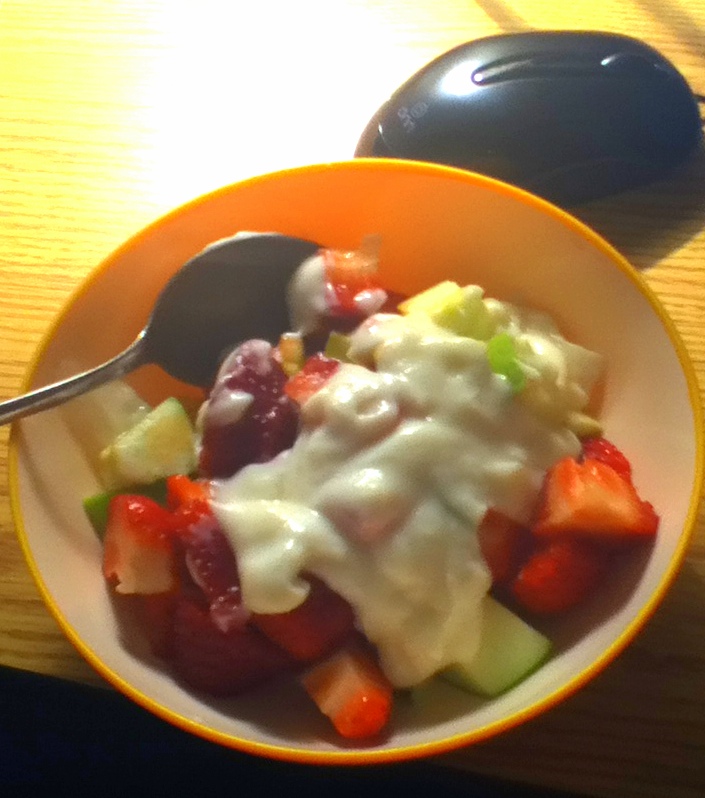
Speaking of food, I now interrupt this blog post because my 8th grade son just brought me a big bowl of fresh fruit salad with vanilla yogurt.  Yum.

Dinner is usually around 6:30, and after that we have free time, clean up, or more school work if not enough of that got finished earlier.  (I often help kids with school work in the evening and on weekends.)   The kids go to bed sometime between 9 PM and midnight, depending on their age and if something exciting is happening or not. 

So that's how we supposedly spend our days.  It rarely works out just like that, but you get the gist of it anyway.

You might also like a related post I wrote this morning: 

Who is the Proverbs 31 Woman? Not Me Yet!


What is your home school day like?

Virginia Knowles
www.StartWellHomeSchool.blogspot.com

P.S. This post will be linked at these other blog parties:


P.P.S. In case you missed my e-book, e-magazine and blog links at the top of this post, here's the rehash...

E-Books:


Blogs:
E-magazine:

Friday, October 5, 2012

Stuff I Never Taught Them

Stuff I never taught them, but they know anyway....

  • Nursing
  • Copy editing (beyond the basics, anyway)
  • Wedding photography
  • Video special effects and other tech savvy stuff
  • Magic tricks
  • Drawing birds in detail
  • Skate board riding and repair
  • Country cooking
  • AP Chemistry
  • Knitting
  • Soccer
  • Basketball
  • French
  • Italian
  • Spanish

So much more....

My ten children -- ranging in age from 7 to 25 -- have learned so much and taught me so much.   Just today, I listened to my oldest daughter intelligently discuss Nicomachean ethics with my sister.  I had absolutely no clue what they were talking about.

Ladies, if you're just getting started in home schooling, don't blow a gasket thinking of teaching them everything they will ever need to know.  You can't.  They can learn jolly well without you if they are interested enough.

Just give them the basic skills.  Read. Write. Speak in public.  Do math. Draw. Science and history too, of course!

Give them the tools for what interests them - butterfly nets, cookbooks, computer software, a camera.  

Let them take time to tinker, explore, take things apart. Making mistakes is part of the learning process.

Classes, clubs and mentors can help in areas where you don't know as much as they want to know.

Have fun learning new skills from your kids!

Virginia Knowles
www.StartWellHomeSchool.blogspot.com


Friday, August 24, 2012

What We're Doing for Elementary School This Year

Dear friends,


Blue orchids!

We're just finishing up our second week of "back to school" at our house.  This year, two of our children are in the elementary grades -- one in public school and the other at home.  We also have two in middle school at home, two in high school (one of them dual enrolling in college, the other at home) and two others in college.


First Day!
My 4th grade son has returned to our neighborhood public school, where he went most of last year, and we're all pretty happy with that choice.  He says his teacher (who just graduated from college) is strict but he likes her.  He has homework every night, so I still get to be involved in his education.  They are doing Florida History this year, so I know he'll be going on a field trip to St. Augustine this year. (See Florida Field Trips #1: Historic St. Augustine)


He is supposed to read from a book of his choice for 20 minutes each evening, so he  was thrilled with the National Geographic Reptiles and Amphibians and the Exploring Your Solar System books my sister (who home schooled two of her kids for several years) just sent after cleaning off her shelves.  He had a choice of what to do with his spelling words yesterday, so he wrote them in graffiti style. :-)

My youngest daughter just turned seven.  She is technically in 2nd grade, but it's more like 1st/2nd since she has an August birthday and is a bit of a "late bloomer" anyway when it comes to academics.  She was in public school for a few months last year but didn't thrive there; they push hard in the early grades and she wasn't quite emotionally ready for that. Even though she learned a lot, she was still behind the other students.  She is, however, very bright, observant and curious, which makes it a lot of fun for me to teach her.  She struggled with reading last year, but really took off in the late springtime and over the summer.  She's my 10th child, and I'd say she's in the normal spectrum of reading skills.  Some of my kids learned to read at age four, and some more toward seven.  They are all strong readers now.  In fact, the child who learned to read at the latest age made top scores on AP tests in high school and starts college dual enrollment next week at age 17.  Some kids just need a little extra time to come into their own. (See my article: Learning to Read.)

Math is the weak link in the chain at the moment, but I'm guessing that will click soon, too.  Her brother was math-resistant in second grade (I could hardly get him to do any!) but shot to the top of his class when he started public school partway through third grade -- again a matter of readiness.  I didn't sign her up for the math class in the home school co-op, so I'm doing a variety of things at home, including ideas from Saxon 1st grade teacher manual, a workbook from a teacher's store, A Beka number pages, hands on stuff like poker chips and penguin shaped crackers (from Aldi), and most of all a free math drill app -- Instant Interactive Math Drills Lite -- on my iPod.  In the photo at left, she matched up two sets of the A Beka number pages on the living room floor (numerals to pictures -- the cards are reversible) and then counted out the poker chips for each one.  This morning we took a pile of six similar science books, counted them, divided them into groups of twos and threes, classified them by topic and cover style, compared the the quantities in the classified groups, etc.  Yes, a lot of our math is impromptu.  If you would like to see more of what I have written about math, read here: Math Skills Checklist from Preschool to 2nd Grade, Math Skills Checklist 3rd-5th Grades and My Own Batch of Cookies (math through measurement). If you want to find out my favorite math resources, read to the bottom of the page here: Math.

Daily Language Review Grade 2   -     
        By: Jo Ellen Moore
    
Many of the classes in our co-op are multi-grade.  She's in 1st-3rd grade for history and science and 1st/2nd for English.  The teachers chose BJU Press for both history and science.  The English teacher is using First Language Lessons for the Well-Trained Mind as her teaching guide.  She sends home worksheets and then the kids do several lessons from the appropriate grade level of Daily Language Review.


We are supplementing all of the co-op classes with additional reading in those subjects at home.  Sometimes I read to her, sometimes she reads to me, and sometimes we take turns reading page by page.  As I mentioned, my sister just sent two big boxes of books, so we should be set for quite a while with Usborne Starting Point Science, Little House early readers, dolphin books, math drill pages, Bible stories, etc.  


Fancy Nancy by Jane O'Connor
We also take frequent trips to the library, where we recently discovered the Fancy Nancy readers. (See here for review.) 

Plus we already have hundreds of children's books at home!  One of our almost daily picks is The Jesus Storybook Bible, which is a bit more poetic and artsy than most kiddy Bible story books.  See my review here: The Jesus Storybook Bible: Every Story Whispers His Name.

I keep her current books and workbooks, school supplies, and a notebook for storing in-process and completed papers, in a clear plastic bin I bought for $5 at Walmart.  It has a spot on a shelf in the dining room, but I usually leave it in the living room where we use it most. See my post: "Bin There, Done That" (Or How to Keep School Clutter from Turning You Into a Basketcase)

I also try to extend the co-op themes with outings and activities.  They have been learning about the library and the post office in history class, so off we go.  They are studying plants in science class, so we went to Lowe's, looked at a lot of different kinds of flowers, and bought some marigolds.  (I blush to say we still haven't planted them and they are shriveling up.  Bad mommy!)  We also have a Fun Pass to Sea World, thanks to some help from my mom.  If you pay for one day, the rest of the year is free!


Another area we're trying to work on is basic life skills.  Each of my five younger children (2nd-10th grades) has the same chores, rotated daily.  I help our youngest with hers so she can get trained well enough to do them independently.  Messy bedrooms are still an issue here, so I checked out Making My Room Special: Creative Ways to Decorate Your Room by Emilie Barnes.  The book uses an engaging story and lots of sidebars to teach elementary age girls how to keep their bedrooms clean, well-organized, and decorated, as well as how to successfully share a room. 


That's mostly what we are doing this year for the elementary grades!

If you would like some more inspiration, check out one of my favorite blogs about home schooling, www.simplehomeschool.net.  I susbscribed via Google Reader.  Two of my recent favorite "don't miss" posts are: Bloom’s Taxonomy: A simple roadmap to learning and Designing big plans to work with your every day.

Thanks for reading!  

What are you doing for elementary school this year?  What are your favorite resources?  Leave a comment and share!

Virginia Knowles
www.StartWellHomeSchool.blogspot.com

Saturday, April 14, 2012

How to Plan a Unit Study


HOW TO PLAN A UNIT STUDY
by Virginia Knowles
from


What is a Unit Study?
Steps for Planning a Unit Study
Long Range Planning
Unit Study Topic List

WHAT IS A UNIT STUDY?

Unit study is a natural common sense excellence method of learning in which you choose a theme, and then incorporate various school subjects, such as literature, language arts skills,  history, geography, careers, science, technology, art, music, and math application.  There is a  logical connection between subjects.  They all fit together naturally, just like in the real world. 

Each unit study is different.  Some unit studies concentrate primarily on one subject (history, science, etc.) with the others tucked in.  Some are based on holidays or family trips. Some are more activity-oriented, while others are book-based, depending on the topic and your teaching style.  You can design your own unit study plan, buy a package or guide, or borrow from a friend.  Unit studies can take a few days, week, month, or year. You could do them all year or just once in a while.  You can plan several at a time or do one spontaneously based on a question or interest from your child.  Don't get bogged down in details.  If a unit study bombs, you learn how not to do one the next time. 

A unit study doesn’t have to be elaborate. It can be as simple as going to the library and checking out a few books.  Find what style suits you.  Don't be discouraged if you are not creative or organized.  You don't have to plan a whole year of unit studies ahead of time, or overload on creative activities in each one.

A unit study can include more than one child, but individual attention is still needed.  One goal of unit studies is to build family unity and save mom's planning efforts, but you still need to spend separate time on language arts and math at each child's level.  It may be helpful to plan one time of day for skills curriculum (phonics, grammar, punctuation, math, music theory, etc.) and then another time slot for content curriculum (unit studies covering history, literature, science, art appreciation, etc.) 

Social studies and science themes can be closely integrated.  Human culture and the physical world affect each other.  People discover scientific principles and then act them out in history.   When we studied Ancient Egypt, a history theme, we learned science too: how a mummy is made, how pyramids were built without machines, and how land was irrigated.  In our next unit, we studied the entire desert habitat, including biology (plants and animals), geology (sand dunes), weather (rain patterns), geography (comparing deserts around the world), history (archaeologists), and sociology (Native Americans, African nomads).  Social studies and science emphases can be alternated and intertwined.  

Language arts and math can be incorporated into unit studies.  Research and literature count as reading. Spelling and vocabulary lists, creative writing projects, and dictation selections, and math word problems can complement the unit study.


A Page from a 3rd Grade Notebook

Spelling List about Mexico 
  • Mexico
  • Central America
  • Maya
  • Aztec
  • pyramid
  • temple
  • solar calendar
  • weave                           
  • cotton
  • vanilla
  • chocolate
  • jungle        

STEPS FOR PLANNING A UNIT STUDY

TOPIC AND TIME AVAILABLE:  Pick a topic which is interesting to your children, and which incorporates several school subjects.  Whatever you choose, your child should:   hypothesize, integrate related information, analyze, research, read, write, etc.  How much time you can spend determines how specific you can get with your topic. You could cover flowers in a week, but botany could easily take a month.  Children usually start to lose interest after about three or four weeks of concentrated study on a topic; don’t frustrate them with overkill.

SUB-TOPICS AND SCHOOL SUBJECTS: Make a list of sub-topics for your theme.  A study of the Middle Ages could include castles, knights and weaponry, the Crusades, Vikings and their ships, famous kings, peasant life, food and clothing, fairy tales, etc.  As you list the sub-topics, integrate various school subjects such as: Bible, scientific principle, experiments, technology, nature study, history, geography, government, careers, language skills, literature, creative writing, math application, art, music, life skills, etc. 

OBJECTIVES: Write specific goals of what you want your child to understand by the end of this unit.  You won't learn everything, but you should attempt to lay a framework for future learning and whet their appetites to explore more on their own. 

LEARNING MODES: Adapt activities to your children. Cater to their learning styles, whether visual, auditory, kinesthetic/tactile, etc.  Use a variety of approaches to help lock in the material from many angles.  Consider each of your children when you do this planning.   Be sure to ask them for ideas about what they would like to do for this unit study, because children can be chock full of great ideas.  It also gives them a sense of being included and being important!

AGE LEVELS: Preschool and kindergarten children especially like picture books, fun songs, coloring, and make-believe.  Primary grade children can read books, write a little, draw pictures, make crafts, and do simple experiments. Older students can research, write papers, create independent projects, and wrestle with issues and current events. Choose some books to read to all of your children and then give age-appropriate activities to each child, with older doing more than younger. Older children can occasionally help younger children by reading to them, assisting with projects, and answering questions.

RESOURCES: List what you already have: books, encyclopedia articles, videos, music, magazines, recipes, instructions, pictures, craft and experiment supplies, web sites and phone numbers to call for more information.  Include titles, authors and page numbers so you can easily make assignments.  Check the indexes of any poetry or story anthologies you may own.  Write down what you will need, and where you might find it. Make games, worksheets, and pictures.  Plan purchases and order in time.

SCHEDULE: Map out a tentative schedule.  What will you do each day?  How much will you cover in a week?  For a three-week unit, you could tackle one major sub-topic each week.  You might need to raid the library first and refine your day-by-day plan based on your selections.  Vary activities from day to day to prevent boredom.  Start with the simple and work towards the complex.  Plan buffer time and decide which activities are optional so you'll know what to skip in a crunch.  Check newspaper and magazine calendars for field trip ideas.

LONG RANGE PLANNING

Several years ago, as I was looking to the future of our home education program, I decided that we needed a plan so that we could learn about various topics and school subjects in a reasonable manner.  From those early brainstorms hatched the idea for a quasi-comprehensive list of 60 three-week unit studies to be covered in five years.  We successfully finished the units in our list a couple of years ago, and we’ve gone on to other schemes since then.  An adapted version of our unit study list is included here, and is organized by school subject, rather than the sequence our own family did them.  This purpose of this list is just to give you an idea of how things can fit together in a long range plan, even if you don’t decide to do a sequenced series of units.  For example, you could study history chronologically and continually (without breaking it up into separate units), cover one continent all throughout the year, and layer various science, technology, and health topics on top of whatever history and geography you are studying at the moment.  (This is what we’ve been doing for the past two years.  It works.) Please note that the “Spiritual Emphasis” listed for each year is not a separate unit, but an overall theme for the year.
 UNIT STUDY TOPIC LIST

YEAR 1
  • History: Old Testament, Ancient Egypt, Ancient Greece
  • Geography: Africa
  • Science: Creation Week, Weather, Life in the Desert
  • Health: Babies and Family Life
  • Technology & Trade: Books and Publishing
  • Spiritual Emphasis: Old Testament

YEAR 2
  • History: Ancient Rome, Life and Times of Christ, Early Church, Viking Times
  • Geography: Ancient and Modern Asia
  • Science: Farm Life, Chemistry, Animal Classification
  • Health: Human Body
  • Technology & Trade: Buildings (Homes, Construction, Architecture)
  • Spiritual Emphasis: New Testament Church and World Missions

YEAR 3
  • History: Middle Ages, Renaissance, Reformation, Explorers, Art & Music History
  • Geography: Europe, Land Forms, Maps & Globes
  • Science: Physical Science, Life in the Water, Plant Life
  • Health: Nutrition & Exercise
  • Technology & Trade: Ships, Musical Instruments
  • Spiritual Emphasis: Reformation of the Church

YEAR 4:
  • History: 17th-19th Century History (U.S.A.: Pilgrims, Colonial, Patriot, Pioneer, Civil War)
  • Geography: North and South America
  • Science: Life in the Forest, Birds
  • Health: Medicine & Health Care
  • Technology & Trade: Inventions & Modern Manufacturing, Communications
  • Spiritual Emphasis : Liberty and Justice

YEAR 5:
  • History: Regional History (State/Province), 20th Century, World Wars, Life in the Future
  • Geography: Regional Geography, Middle East, Australia
  • Science: Insects, Flowers, Astronomy
  • Health: General Health
  • Technology & Trade: Aviation, Space Travel, Energy, Economics
  • Spiritual Emphasis : Spiritual Growth
&

“The more I study nature, the more I stand amazed at the work of the Creator. 
Into his tiniest creatures, God has placed extraordinary properties.”
Louis Pasteur (1822-1895), the French scientist who developed process of pasteurization for milk, as well as vaccines for anthrax and rabies


1-2-3 Ideas to Remember about
Teaching with Unit Studies

  1 Keep unit studies simple!  Don’t feel overwhelmed!

  2    Integrate many school subjects in a natural way.

  3    Plan spontaneously or long-term.


Other unit study posts on this blog:

Related Posts with Thumbnails